Written By:
Sinéad SmythUpdated on:
One of Inishowen’s best-preserved megalithic tombs from the Bronze Age
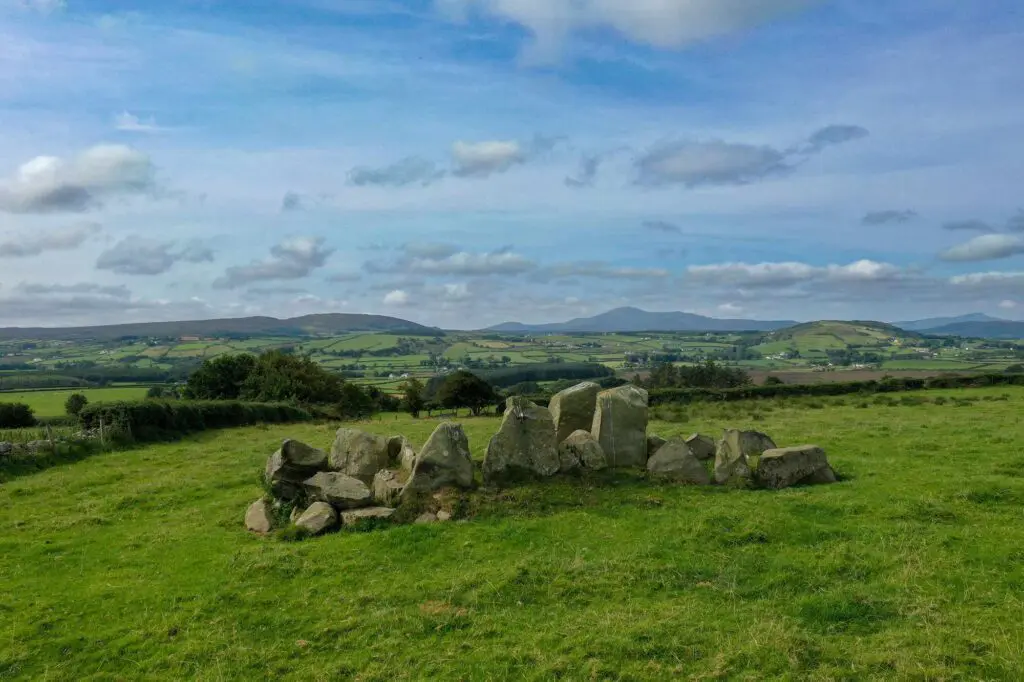
View all placesSet quietly among the rolling fields near Culdaff, directly across from Bocan Stone Circle, the Temple of Deen stands as one of Inishowen’s most striking and well-preserved megalithic tombs.
Also known locally as Laraghill Cairn, this remarkable site dates to between 1500 and 2000 BC, making it one of the oldest surviving built structures on the peninsula. Though modest in scale, its structure, setting, and state of preservation make it an important stop for those interested in Ireland’s ancient past.
The Temple of Deen is classified as a wedge tomb, a type of megalithic burial monument that emerged in Ireland during the Bronze Age. These tombs typically feature a narrowing rectangular chamber built with large stone slabs, topped by cairn material or earth, and often oriented with an entrance facing southwest — possibly aligning with the setting sun during certain times of year.
At the Temple of Deen, this structure remains remarkably intact. Visitors can clearly see the outline of the tomb chamber, flanked by heavy upright stones that have stood in place for over 3,500 years. Though the cairn material that once covered the tomb has largely eroded or been removed, the arrangement of the stones allows you to visualise how it once looked — and to appreciate the skill required to construct such a monument with the tools and knowledge of the time.
The survival of this tomb for millennia is a powerful reminder of how the early inhabitants of Inishowen connected their lives, deaths, and cosmology to the land in enduring ways.
The location of the Temple of Deen — directly across the road from Bocan Stone Circle — suggests that this area held special significance in prehistoric Inishowen. Together, these two monuments form part of what was likely a larger ritual or ceremonial complex, where life, death, and spirituality were expressed through architecture, astronomy, and careful placement within the landscape.
It’s easy to imagine the Temple of Deen as the burial place of a respected figure or group — someone whose resting place was designed not only for remembrance but to remain part of the living land. The open views across the Culdaff countryside, the alignment of the stones, and the proximity to Bocan suggest a community deeply attuned to their environment and the cycles of the natural world.
Access to the Temple of Deen is straightforward from the Culdaff to Bocan road, with clear sightlines from the roadside and informal paths leading to the monument. Visitors are reminded that the site lies on or near private farmland, and respectful, low-impact exploration is essential.
The monument is often overlooked by casual passers-by, but those who stop are rewarded with a sense of quiet discovery. The surrounding fields, shifting skies, and ancient stones combine to create a mood of reflection — a space where past and present feel closer together.
Bring a camera, a notebook, or simply your attention. This is a place to pause, to listen, and to consider the lives that shaped the land long before our own.
The Temple of Deen joins a constellation of ancient sites across Inishowen — including Bocan Stone Circle, Bocan Graveyard, the Giant Stone in Muff, and the rock art of the Isle of Doagh — that together tell the story of the peninsula’s early spiritual life. For anyone tracing the megalithic and Bronze Age heritage of Donegal, this site is not to be missed.
A selection of our pics


Located close to Carndonagh and central to Inishowen, our traditional Irish cottage offers a peaceful, private stay in one of Donegal’s most scenic regions.